
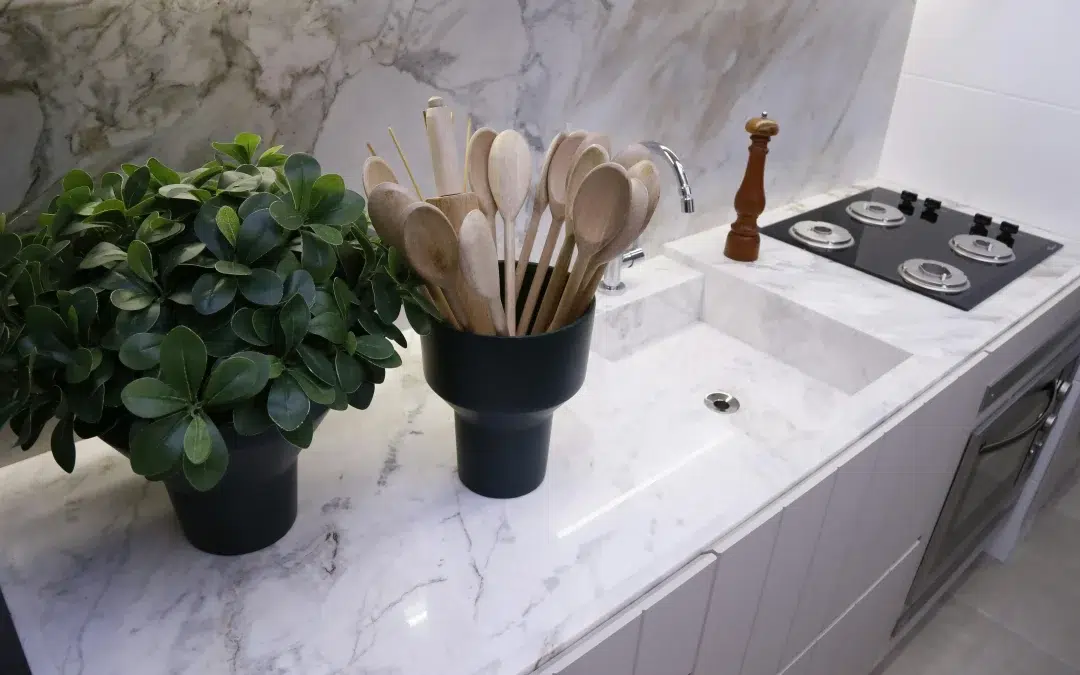
Marble is a revered stone worktop material known for its elegance and sophistication, but one thing that makes it truly special is its veining. If you’re curious to know why marble veining happens and how it contributes to marble’s unique appearance, don’t go anywhere. We’ll be covering all things veining in this helpful guide.
What Causes Marble Veining?
Firstly, let’s explore what it is that gives marble its unique veined appearance. Marble veins form deep underground when limestone (made mostly of calcite from ancient shells and coral) is transformed by intense heat and pressure over millions of years. As this happens, mineral-rich fluids move through tiny cracks and layers in the rock alongside impurities like iron oxide, clay and silt. These eventually crystallise, creating the beautifully varied lines and patterns we see in marble worktops today.
Common minerals you find in marble veining:
- Quartz
- Calcite
- Dolomite
- Pyrite
- Iron oxides
- Chlorite
- Graphite
As well as adding patterns, each of these minerals gives the marble its distinctive colours.
How We Know Marble Veins are Unique
Did you know that marble is geologically non-repeatable? This means that no two slabs of marble are ever the same, much like a human fingerprint. Each slab is cut from a specific area of the quarry, and within that quarry, variations in factors like pressure levels, fluid movement and natural fractures form the stone’s unique features. While many expert stone manufacturers use AI pattern mapping and other technologies to try to replicate marble’s look, it’s impossible to achieve a perfect match. Even under a microscope, each piece shows subtle differences that make it one of a kind.
Common Marble Veining Patterns
Marble’s unique veining patterns may set different slabs apart, but there are some similarities when it comes to style. Got your eye on marble for your stone kitchen worktops? Look out for the following patterns and designs:
Linear or Striated Veining: Some marble slabs have veining that forms as consistent parallel lines. These develop when minerals align along the rock’s original layering during metamorphism, creating long, uniform bands.
Brecciated (Broken/Angular) Veining: This striking veining often appears as mosaic-like with angular fragments that are formed when rock cracks and refills.
Cross‑Cut or Cloudy Veining: This pattern forms when marble is cut perpendicular to its natural bedding planes. Instead of long lines, you get soft, swirling, cloud‑like patches with gentle, irregular veining.
Dramatic or Bold Veining: Some marbles develop thick, high‑contrast veins that sweep across the slab in striking, irregular paths. These veins often form where larger fractures once existed, later filled with minerals like quartz or iron oxides.
Prefer a minimalist look for your home? Deep veining can be quite dramatic, so think wisely about where you’ll use it. If you’ve got your heart set on a heavily veined slab but don’t want it to dominate, focus on balance. You could go for a large central island with matching backsplashes, and then offset it with light, neutral counters. This will stop your space from becoming visually cluttered or “busy”.
The Impact of Veining on Cost
When it comes to marble worktops, veining doesn’t just affect appearance – it plays a significant role in pricing too. Generally speaking, the more dramatic and distinctive the marble veining, the greater the cost. As you might expect, slabs with bold, sweeping veins or rare colour combinations tend to come in at a higher price point. Meanwhile, marble with subtle or minimal veining is often more affordable, though no less beautiful.
Beyond aesthetics, the rarity of the marble type and the difficulty of extraction also factor into cost. Some quarries produce limited quantities of highly sought-after veined marble, which naturally drives up the price. Ultimately, how much you pay depends on your budget and the statement you want your worktop to make.
Does Marble Need Sealing?
Yes! Sealing is a must for marble worktops as it helps to maintain their beauty and protect them from staining. Because marble is a natural, porous stone, it can absorb liquids like wine, oil, or acidic substances, which may lead to discolouration or etching over time. By applying a high-quality sealant, we’re able to create a protective barrier that helps to prevent moisture and spills from penetrating the surface.
We recommend sealing marble worktops at least once or twice a year, though this will depend on how heavily the surface is used. Fortunately, sealing is a straightforward process, and when done regularly, it keeps your marble veining looking vibrant and fresh.
Why Veined Marble is Having Its Moment
Veined marble has seen a huge surge in popularity recently – and for good reason. Not only is marble timeless and captivating, but it’s also incredibly durable. These days, modern homeowners want quality pieces that last. Instead of wasting money on faux features and vinyl wraps that need replacing every 6-12 months, people are investing in elegant, eye-catching designs brought to life by quality craftsmanship. These pieces help to create spaces that can be used by the whole family and enjoyed long into the future.
Invest in Elegance with a Worktop from Marble Supreme
Ready to bring the timeless beauty of marble veining into your home? Our experts are here to help. At Marble Supreme, we specialise in sourcing and crafting exceptional marble worktops that showcase the natural artistry of this stunning stone. Every slab is carefully selected for its unique veining and quality, giving you a long-lasting worktop that’s truly one of a kind. Whether you’re drawn to subtle elegance or bold, dramatic veining, we have it all here. Get in touch with us today to transform your home with premium, handcrafted stone.