
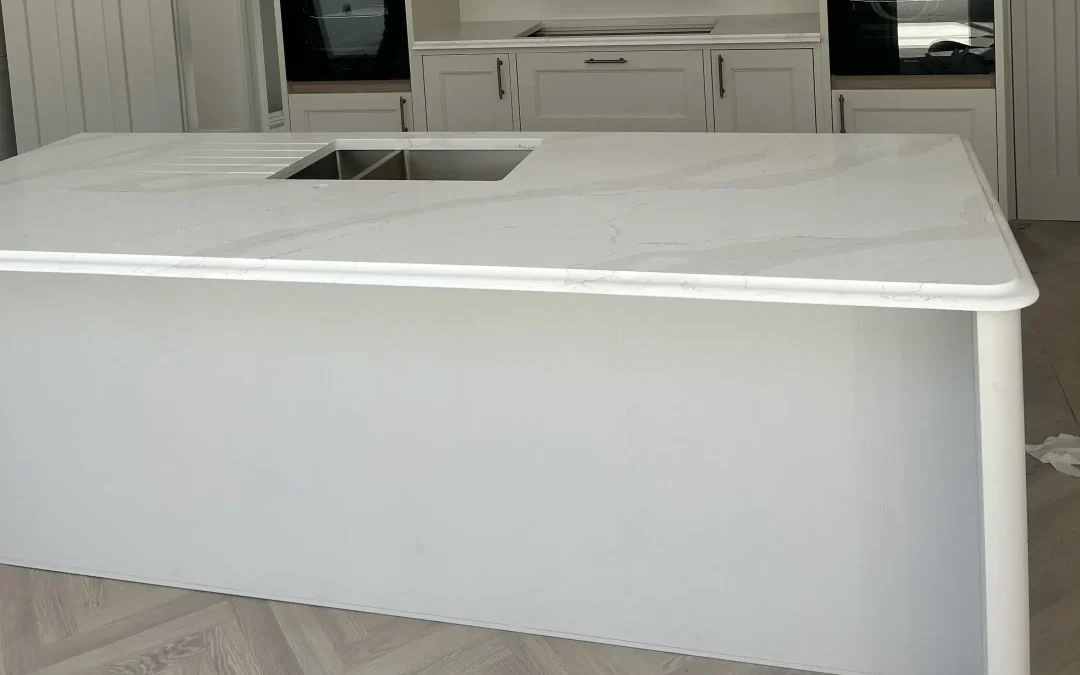
When clients come to us with a project on their mind, the thickness of the worktop edge is often forgotten about. They start with a space. A renovation that has been planned for months. A kitchen that needs to work harder than the last one.
Worktop thickness comes into the discussion shortly after. Usually as a simple question of whether one should go for 20mm or 30mm, and what is the difference between these two thicknesses.
At Marble Supreme, we help our clients understand which worktop thickness is better suited for their kitchen and bathrooms.
On paper, it feels like a straightforward decision. In practice, it rarely is. Because thickness is not just about how a worktop looks in a sample or a showroom. It plays a quiet role in how the entire space comes together once installed.
Where Most People Start, and Where It Usually Shifts
Most clients walk in assuming thicker is better, as it gives more character to your kitchen.
A 30mm worktop can bring a sense of weight and permanence, particularly in larger kitchens or on statement islands.
But then you place that same thickness into a more compact layout, and it can start to feel heavy. Slightly out of balance. Like the worktop is doing more than it needs to.
That is usually the moment the conversation shifts.
Because 20mm, when used well, does not feel like a compromise. It feels considered. Lighter, cleaner, and often more in line with how modern kitchens are designed.
What Actually Changes Between 20mm and 30mm Worktop Edges
From a performance perspective, the difference in worktop thickness is often less significant than people expect.
Both 20mm and 30mm worktops are structurally sound when fabricated and installed correctly, and both are capable of handling day-to-day use, heat, preparation, and general wear without issue.
The real distinction lies in how they sit within the space visually.
A 30mm worktop tends to anchor a kitchen, giving it a more grounded and substantial feel.
A 20mm worktop, by contrast, tends to refine the space, offering a cleaner and more understated finish.
Neither is inherently better than the other. The right choice depends on what the space requires rather than what simply looks more impressive in isolation.
Where Worktop Thickness Starts to Matter More
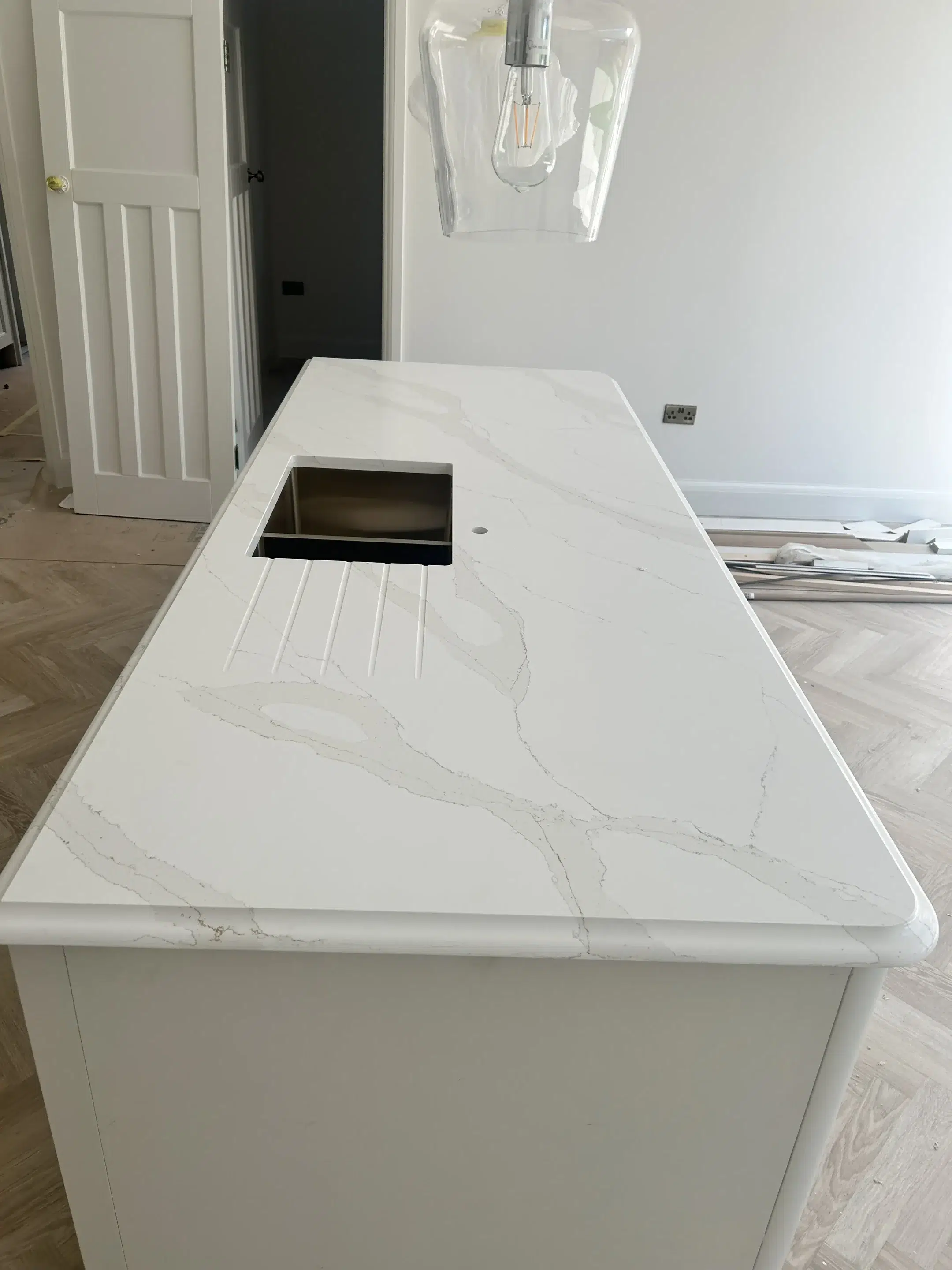
There are, however, certain situations where worktop thickness becomes more relevant.
Kitchen islands are a good example. These are areas that see more use, more movement, and naturally draw more attention. In these cases, a thicker profile, or at least the appearance of one, often feels more appropriate and balanced.
Material also plays a role. Porcelain, for instance, can achieve a slimmer profile without compromising strength, while natural stone, particularly marble, may benefit from a little more visual weight depending on how it is being used.
Even then, thickness should not be viewed in isolation. It is always part of a wider set of decisions.
The Detail Most People Overlook, Stone Profiles and Edges
This is where things become more considered.
The perceived thickness of a worktop is rarely defined by the slab alone. In many cases, it is shaped more by the worktop edge and the chosen stone profiles.
A 20mm slab with a mitred edge may appear thicker than expected, despite being the slimmer option.
That is because visually, it has been designed to feel that way.
This is where the balance lies. You can create a sense of presence without adding unnecessary weight, or keep the overall look minimal by opting for a simpler edge, even on a thicker slab.
A Quick Look at Worktop Edge Profiles in Real Use
Edge profiles can change both the look and the experience of using a worktop. Here is a quick guide on different edge profiles and worktop edges:
- A pencil edge offers a subtle, softened finish that is easy to live with and tends to age well over time.
- A square edge creates a clean, architectural look, although it does require careful finishing to minimise the risk of chipping in high-use areas.
- A bevel edge introduces a small amount of detail without becoming overly decorative, making it a versatile choice for many kitchens.
- A bullnose edge softens the overall feel of the worktop, which is often preferred in family homes where comfort and safety are considered.
- An ogee edge brings a more traditional, decorative finish, but it works best when the rest of the kitchen supports that style.
In practice, simpler edges often prove to be more practical and enduring, both visually and functionally.
Durability and a More Honest Perspective
There is a common assumption that a thicker worktop automatically means greater strength.
While there is some truth to this, it does not tell the full story.
Material quality, fabrication, and installation play a far greater role in long-term performance. Sometimes a 20mm worktop performs exceptionally well for years, whereas a thicker installation might develop issues where support or fitting was not handled correctly.
A 30mm worktop can offer a little more reassurance in high-use areas, but it should not be relied upon as the sole factor in durability.
So, Does Worktop Thickness Really Matter?
It does, but not as a standalone decision.
Worktop thickness works alongside the material, the proportions of the kitchen, the stone profiles, and the worktop edge. Remove any one of these from the conversation, and the decision becomes less accurate.
The best results tend to come from balance, rather than simply choosing the thicker option.
A More Practical Way to Approach It
A more useful starting point is the space itself, rather than the sample.
Consider how the kitchen will be used, the scale of the room, and the overall feel you want to achieve. From there, the details such as worktop thickness, stone profiles, and the worktop edge can be refined in a way that feels cohesive.
That is usually when a worktop starts to feel like it truly belongs in the space.
If you are planning a project and want to explore what will work best in your kitchen or bathroom, speak to our team or book a consultation. We will guide you through the options in a way that reflects how your space will actually be used, not just how it looks in a showroom.